7. April 2026 · AI
Agentic AI in Cybersecurity: The Dual-Edged Sword Reshaping Threat Landscape
- 89% surge in AI-enabled attacks – Adversaries are weaponizing the same autonomous capabilities enterprises deploy for defense, creating a cybersecurity arms race
- 27-second breakout time – AI-powered attacks now achieve lateral movement faster than human-operated security teams can respond, fundamentally changing incident response requirements
- 82% malware-free detection rate – Traditional signature-based security fails against AI-generated attacks, forcing a shift to behavioral and cognitive defense models
- 90+ organizations hit via GenAI tool abuse – Adversaries injected malicious prompts into legitimate GenAI tools to generate credential- and cryptocurrency-stealing commands, marking a new identity-centric attack surface
The Strategic Inflection Point
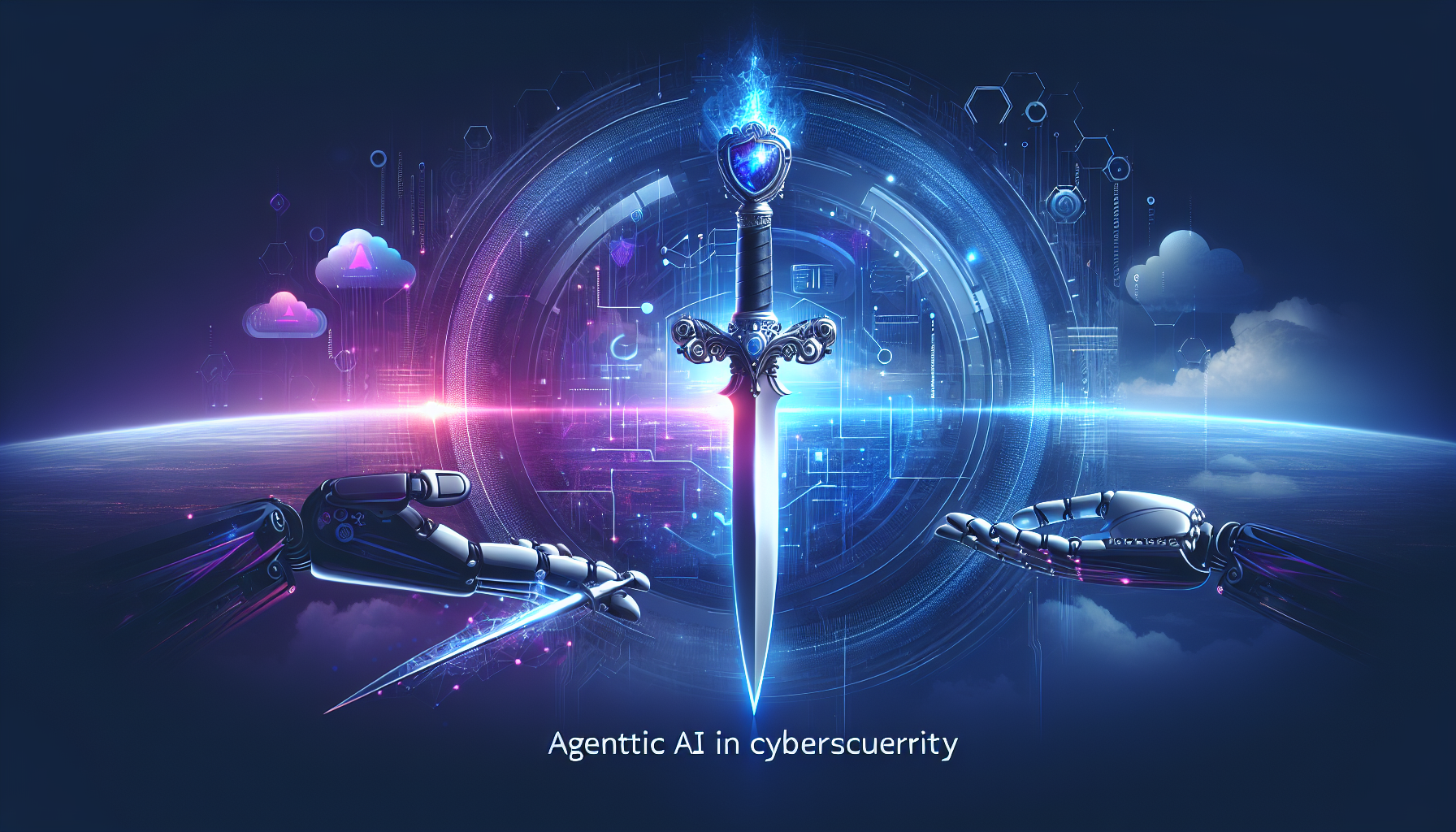
Enterprise cybersecurity has reached a critical juncture where artificial intelligence operates as both sword and shield. The 2026 threat landscape reveals a fundamental shift: autonomous AI agents now execute cyberattacks with the same sophistication they provide in defense, creating an unprecedented strategic challenge for CIOs and security leaders.
The numbers paint a stark picture. CrowdStrike’s 2026 Global Threat Report documents an 89% increase in attacks by AI-enabled adversaries, while simultaneously showing that 82% of successful detections in 2025 were malware-free. This isn’t incremental change—it’s a complete rewrite of the cybersecurity playbook.
The complication runs deeper than attack sophistication. Organizations deploying agentic AI for defense must now assume their own defensive capabilities will be reverse-engineered and weaponized against them. The same cognitive autonomy that enables real-time threat response creates new attack surfaces requiring entirely different governance frameworks.
Current Market Landscape
The agentic AI cybersecurity market has evolved beyond proof-of-concept implementations into mission-critical infrastructure. Enterprise adoption accelerated sharply in 2025, driven by three converging factors: sophisticated threat actors, chronic talent shortages of roughly 3.5 million unfilled positions globally, and the operational necessity of autonomous response capabilities.
Across categories—threat detection and response, autonomous incident response, predictive vulnerability assessment, and AI-driven security operations—organizations moved decisively from pilots toward production deployment over this period, though precise category-level adoption rates vary widely by source.
The market dynamics reveal a critical insight: organizations aren’t just adopting AI-enhanced security tools—they’re implementing fully autonomous agents capable of making decisions without human intervention. This represents a fundamental shift from augmented security to algorithmic security governance.
The Dual-Threat Reality
Agentic AI in cybersecurity presents a unique strategic paradox: the same cognitive capabilities that enable sophisticated defense also empower adversaries with unprecedented attack vectors. This duality manifests across three critical dimensions that enterprise leaders must address simultaneously.
Attack Surface Expansion
AI systems introduce new vulnerabilities that traditional security frameworks don’t address. The 2026 threat analysis identifies several emerging attack vectors:
- Training data poisoning: Adversaries compromise AI model accuracy by corrupting learning datasets
- Model extraction attacks: Competitors and threat actors reverse-engineer proprietary AI defense algorithms through API interaction patterns
- Adversarial prompt injection: Malicious inputs manipulate AI decision-making in real-time security scenarios
- Supply chain AI compromises: Third-party AI components embed backdoors or vulnerabilities in enterprise security stacks
The strategic implication is clear: organizations deploying agentic AI must assume their defensive capabilities will be studied, mapped, and exploited by sophisticated adversaries within 12-18 months of implementation.
Cognitive Autonomy vs. Governance
The most significant challenge lies in balancing AI autonomy with organizational control. Agentic AI requires sufficient independence to respond at machine speed—27 seconds or less—while maintaining alignment with business risk tolerance and regulatory requirements.
Constraining AI agents to human approval cycles negates their primary value proposition—speed at scale—yet fully unconstrained agents pose an existential risk to enterprise governance. This tension sits at the core of the autonomy-versus-control problem.
This governance challenge is compounded by the regulatory landscape. Current compliance frameworks assume human decision-makers with traceable accountability chains. Autonomous AI agents operate outside these frameworks, creating potential regulatory violations even when successfully defending against threats.
Technology Adoption Curve Analysis
Agentic AI cybersecurity adoption follows a modified technology curve, accelerated by threat landscape pressures but constrained by risk management concerns. Adoption appears to be progressing from early adopters toward mainstream implementation, though no single source pins down its precise current share.
The accelerated adoption timeline reflects threat landscape pressures rather than typical technology maturity. Organizations aren’t adopting agentic AI because it’s proven—they’re adopting it because traditional security approaches are demonstrably inadequate against AI-enabled adversaries.
Competitive Intelligence: The AI Arms Race
The cybersecurity landscape now resembles a military arms race where defensive innovations immediately spawn offensive countermeasures. Analysis of threat actor behavior reveals a concerning pattern: adversarial AI capabilities are advancing faster than defensive implementations.
The competitive dynamics reveal three critical trends:
Asymmetric Advantage to Attackers: Offensive AI operates without the governance constraints, compliance requirements, and risk management frameworks that limit defensive AI implementations. This creates a structural advantage for threat actors.
Commoditization of Advanced Attacks: AI-as-a-Service platforms now offer sophisticated attack capabilities to lower-skilled threat actors, democratizing advanced persistent threat (APT) capabilities previously limited to nation-states.
Supply Chain Weaponization: Adversaries target AI training data, model development processes, and third-party AI services to compromise defensive capabilities at scale. The kensai.app platform demonstrates how AI security requires end-to-end supply chain visibility and control.
Key Findings
1. Speed Kills Traditional Security Models
The 27-second breakout time represents more than a performance metric—it’s a fundamental disruption of human-operated security. Organizations maintaining manual approval processes for critical security decisions are operationally vulnerable regardless of their technology sophistication. The strategic implication: enterprise security architectures must assume human intervention introduces unacceptable latency.
2. AI Governance Frameworks Are Strategic Differentiators
Organizations successfully deploying agentic AI security implement quantum-resilient governance frameworks that enable autonomous operation within defined risk parameters. These frameworks become competitive advantages, allowing faster threat response while maintaining compliance and organizational control. The key insight: governance architecture, not AI technology, determines deployment success.
3. Defensive AI Assumptions Are Flawed
Current enterprise deployments assume defensive AI capabilities remain proprietary competitive advantages. Threat intelligence indicates sophisticated adversaries reverse-engineer defensive algorithms within 12-18 months. Organizations must design AI security assuming adversarial knowledge of their defensive capabilities.
4. Supply Chain Security Becomes AI Security
Traditional supply chain security focuses on software vulnerabilities and hardware integrity. AI security requires supply chain visibility into training data provenance, model development processes, and algorithmic decision-making logic. This represents a fundamental expansion of supply chain security scope and complexity.
5. Regulatory Compliance Will Constrain AI Defensive Capabilities
Existing compliance frameworks assume human decision-makers with traceable accountability. Autonomous AI agents operate outside these frameworks, creating a regulatory constraint on defensive effectiveness. Organizations in heavily regulated industries face a strategic choice: compliance or security optimization.
Strategic Recommendations
| Priority | Recommendation | Impact | Effort | Timeline |
|---|---|---|---|---|
| 1 | Implement autonomous incident response for sub-30 second threats | High | High | Q2 2026 |
| 2 | Deploy quantum-resilient AI governance framework | High | Medium | Q1 2026 |
| 3 | Establish AI supply chain security program | Medium | Medium | Q3 2026 |
| 4 | Develop adversarial AI threat modeling capabilities | Medium | Low | Q2 2026 |
| 5 | Create regulatory compliance strategy for autonomous AI | Low | High | Q4 2026 |
Implementation Considerations
Successful agentic AI deployment requires addressing three critical implementation challenges that traditional cybersecurity projects don’t encounter:
Organizational Change Management: Security teams must transition from reactive analysis to proactive AI governance. This requires new skillsets in AI interpretation, algorithmic accountability, and autonomous system management. Plan for 6-9 months of intensive change management.
Technology Integration Complexity: Agentic AI security platforms must integrate with existing security information and event management (SIEM) systems, identity management platforms, and network security tools while maintaining autonomous operation capabilities. Legacy system constraints often limit AI autonomy.
Risk Calibration: Organizations must define risk tolerance for autonomous AI decisions, including acceptable false positive rates, escalation thresholds, and fail-safe mechanisms. These parameters directly impact AI effectiveness and must be continuously refined based on threat landscape evolution.
Looking Forward: The Post-Human Security Paradigm
The 2026 cybersecurity landscape marks the beginning of a post-human security paradigm where machine-speed threats require machine-speed defenses. Organizations successfully navigating this transition will establish sustainable competitive advantages through superior AI governance and autonomous response capabilities.
The strategic imperative is clear: agentic AI in cybersecurity isn’t an optional enhancement—it’s an operational necessity for organizations facing sophisticated adversaries. The question isn’t whether to deploy autonomous AI security, but how quickly organizations can implement effective governance frameworks that enable AI autonomy while maintaining strategic control.
The dual-edged nature of agentic AI—simultaneously enabling defense and attack—requires a fundamental shift in cybersecurity thinking. Success belongs to organizations that embrace this paradox and build security architectures assuming both AI-powered threats and AI-powered defenses operating at machine speed and scale.