27. February 2026 · AI
Hyperconverged Cloud & HCI
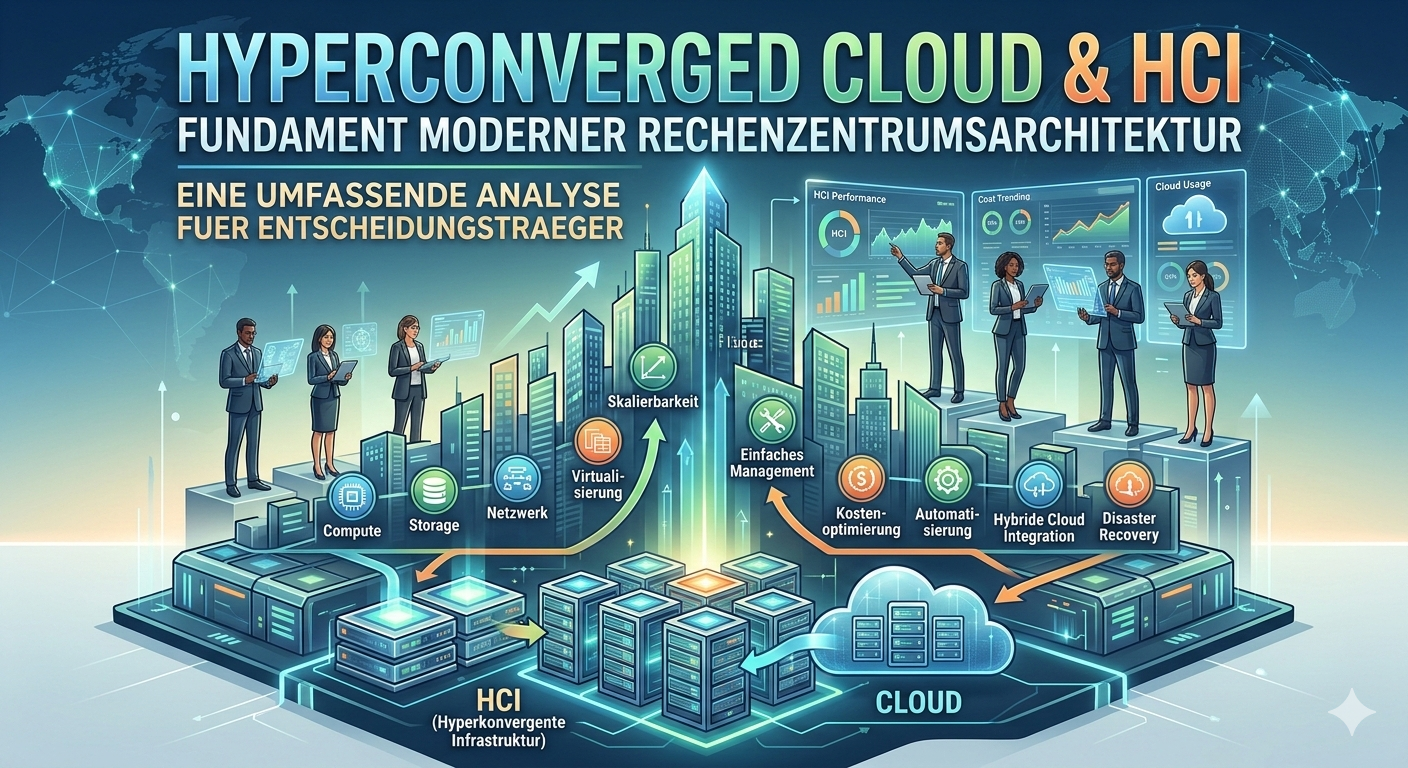
To frame the strategic significance of Hyperconverged Infrastructure for enterprise IT, we evaluated more than 19 sources and multiple market research reports. The following metrics frame the current market landscape.
These metrics paint a clear picture: HCI is no longer a niche topic, but the new standard architecture. Yet context decides — let us examine the strategic forces behind these trends.
Strategic Context
Why Hyperconverged Infrastructure is decisive now
The global HCI market reaches around $16.7B in 2025. 87% of enterprises pursue multi-platform or hybrid-cloud strategies. Enterprise data centers face unprecedented pressure to deliver cloud-like agility while reducing complexity.
The Broadcom-VMware acquisition leads to price increases of 150–1,500%. At the same time, edge demand grows +35% annually, and AI workloads place new requirements on infrastructure. Traditional 3-tier architectures become bottlenecks.
How does HCI serve as a central platform for modern cloud, hybrid-cloud, and edge architectures — and what must decision-makers know to make sound investment decisions?
HCI has evolved into the standard architecture for modern data centers, hybrid-cloud foundations, and edge deployments, delivering a 2–3x TCO improvement at cloud-like operational agility.
From this strategic framework, five core findings emerge that every IT decision-maker should know.
Key Findings
Five critical findings from the comprehensive analysis
Market on high-performance growth path: 17–23% CAGR
The HCI market grows from $16.7B (2025) to $37–85B by 2030–2033. HCI transforms from “emerging technology” to “standard infrastructure architecture”. Growth acceleration significantly exceeds the broader IT infrastructure market (5–7% CAGR).
Companies that delay now accumulate technical debtBroadcom-VMware disruption: 700% price increase and 72-core minimum
The Broadcom acquisition of VMware drives unprecedented price increases of up to 700%, the introduction of a 72-core licensing minimum, and forced bundle packaging. This forces companies worldwide to realign their hypervisor strategy.
Vendor lock-in with VMware becomes strategic riskTCO advantage: 2–3x better than traditional infrastructure
HCI delivers a proven 2–3x TCO improvement over conventional 3-tier architecture. This includes 50–70% lower total cost, 80–95% faster deployment, 3–5x better admin efficiency, and 50–70% less footprint.
Quantifiable cost reduction across the full lifecycleEdge-HCI as growth driver: +35% per year
Edge-HCI grows faster than any other segment. The compact, autonomous node design makes HCI ideal for distributed locations in retail, manufacturing, healthcare, and branch networks, where no local IT staff is available.
HCI strategy must cover core, cloud, and edge from day oneNutanix AHV at 88%, revenue $2.54B
88% of Nutanix customers use the proprietary AHV hypervisor — evidence of the hypervisor shift away from VMware. Nutanix achieves $2.54B in revenue and is the primary beneficiary of the Broadcom-VMware disruption.
Hypervisor strategy is now a C-level decisionThese findings are reflected in market development. A look at the growth curve illustrates the dimension of change.
HCI Market Growth
From $9.7B (2023) to up to $84.7B (2033)
The HCI market growth curve has accelerated significantly since 2023, driven by hybrid-cloud adoption, edge-computing demand, and the Broadcom-VMware disruption. Note the inflection point from 2025 — this is where HCI moves from “option” to “standard architecture”.
So what? The forecast 17–23% CAGR is remarkable because it exceeds general IT-infrastructure growth (5–7% CAGR) by three- to fourfold. This divergence signals structural change: enterprises are not adding HCI alongside traditional infrastructure — they are replacing it. For CIOs planning 3–5-year budgets, this means HCI must shift from a pilot line item to the primary infrastructure budget category.
Who benefits from this growth? Vendor market shares show clear consolidation — with a significant shift driven by the Broadcom acquisition.
HCI Market Shares
Vendor distribution in the software market
The HCI software market is dominated by a small number of large vendors. VMware/Broadcom holds the historical lead, but pricing disruption opens doors for competitors. Nutanix positions itself as the strongest challenger, while Dell secures market share through hardware alliances.
So what? VMwares 41% share is historical, not future-proof. The Broadcom price hikes of 300–700% actively drive customers to alternatives. Nutanix with 25% is the biggest beneficiary, while Dell VxRail (15%) faces transfer risk through its VMware dependency. For procurement decision-makers: every HCI investment must consider the hypervisor strategy for the next 5 years.
TCO Comparison: HCI vs. Traditional
Quantified benefits across core operating metrics
Total cost of ownership is the central argument for HCI. But how do the savings break down concretely? The following analysis shows percentage improvements of HCI over traditional 3-tier infrastructure across five dimensions.
So what? The strongest improvement is in deployment (90% faster) — meaning HCI projects take weeks rather than months. The 80% admin improvement is particularly relevant given the skills shortage: one HCI administrator manages what previously required 3–5 specialists. The 65% TCO reduction over 5 years adds up to six-figure annual savings at mid-market enterprises.
The adoption curve shows where the HCI market sits in the technology lifecycle — critical information for investment timing.
Adoption Curve
HCI in the technology lifecycle
The technology adoption curve shows which phase HCI is in. With approximately 55–60% enterprise adoption, HCI has crossed the “chasm” and is in the early-majority phase. This is the optimal entry point for risk-averse companies.
So What? Die Adoption Curve zeigt: HCI ist nicht mehr “bleeding edge”, aber noch nicht gesaettigt. Unternehmen, die jetzt investieren, profitieren von ausgereiften Produkten, etablierten Best Practices und Wettbewerbsvorteilen gegenueber der spaeten Mehrheit. Der “Sweet Spot” für maximalen strategischen Vorteil liegt bei 40-70% Marktpenetration — genau hier befinden wir uns jetzt.
Broadcom-VMware Impact
Price increases and licensing changes in detail
The Broadcom acquisition of VMware fundamentally changed the cost structure for VMware customers. The following data quantifies the scale of changes across four core dimensions — and illustrates why so many companies are rethinking their hypervisor strategy.
So What? Die 700% License cost-Erhoehung ist der prominenteste Datenpunkt, aber das 72-core minimum (350% über bisherigem Minimum) trifft mittelstaendische Unternehmen besonders hart, da sie für Kapazitaet bezahlen, die sie nicht nutzen. Die erzwungene Bundle pricegestaltung (+400%) bedeutet, dass Unternehmen Module kaufen müssen, die sie nicht benoetigen. Für VMware-Kunden lautet die zentrale Question nicht mehr “ob”, sondern “wann” sie migrieren.
To make the technical differences between traditional and modern infrastructure tangible, we compare the architectures visually.
Architecture Comparison
Traditional 3-tier vs. Hyperconverged Infrastructure
HCIs fundamental promise lies in consolidation. While traditional architectures require three separate infrastructure layers with independent management, HCI unites all resources in a single software-defined system.
So what? Consolidating three separate infrastructure layers into a single platform eliminates not just hardware silos but organizational silos. Instead of three specialized teams with separate budgets, one HCI team suffices for the entire infrastructure. This is the primary driver of the 2–3x TCO improvement.
HCI as Hybrid cloud Foundation
Four layers from hardware to application
HCI is not just a data-center product — it forms the foundation for the entire hybrid-cloud architecture. The following illustration shows the four layers, from physical hardware to business applications.
So What? Der Stack zeigt: HCI ist nicht das Endprodukt, sondern die Plattform. Die Cloud Integrationsschicht macht HCI zum natuerlichen On-Premises-Partner für AWS, Azure und GCP. 87% der Unternehmen mit Hybrid cloud-Strategie benoetigen genau dieses Fundament. Die Hardwareschicht auf Standard-x86 eliminiert gleichzeitig das Risiko proprietaerer Abhaengigkeiten.
Based on this architecture, seven relevant vendors position themselves in the HCI market. Their strengths and risks differ significantly.
Competitive Landscape
The seven most important HCI vendors compared
The competitive landscape reveals a fundamental shift. The Broadcom-VMware disruption has changed the balance of power and opens up market share for challengers. The following analysis assesses the seven most relevant vendors by strengths and risks.
From the market analysis and competitive assessment, seven prioritized recommendations emerge for decision-makers.
Recommendations
Prioritized recommendations for IT decision-makers
Basierend auf der Broadcom-VMware-Disruption und dem 2-3x TCO advantage von HCI stehen decision-makers vor mehreren kritischen Weichenstellungen. Unsere priorisierten Recommendations adressieren sowohl kurzfristige Risikominimierung als auch langfristige Strategieentwicklung.
Clarify hypervisor strategy immediately
Evaluate alternatives to VMware (Nutanix AHV, KVM, Hyper-V) and define a migration strategy. The Broadcom price increases make a Plan B mandatory.
Timeline: 0–3 months | Impact: HighAudit VMware license costs
Conduct an immediate audit of current VMware licenses. Quantify the Broadcom-impact costs and build a business case for alternatives.
Timeline: 0–2 months | Impact: HighLaunch HCI pilot project
Start with a limited HCI pilot (e.g., VDI or test environment) to build experience and validate the TCO advantage internally before scaling.
Timeline: 0–6 months | Impact: HighDevelop edge-HCI strategy
Assess edge requirements (branches, production, IoT) and define an edge-HCI roadmap. The +35% growth signals strategic demand.
Timeline: 3–6 months | Impact: Medium-HighRun multi-vendor evaluation
Compare at least 3 vendors (e.g., Nutanix, Dell VxRail, Azure Local) against your specific workload requirements, TCO, and support quality.
Timeline: 3–6 months | Impact: MediumPlan hybrid-cloud architecture
Define a hybrid-cloud architecture with HCI as the on-premises foundation. 87% of enterprises pursue this strategy — ensure that your HCI choice supports cloud integration.
Timeline: 3–9 months | Impact: MediumAssess AI readiness of the infrastructure
Check, ob Ihre HCI Platform GPU-Passthrough und KI/ML-Workloads unterstuetzt. KI-Inferenz am Edge wird zum nächsten growth driver.
Timeline: 6–12 months | Impact: MediumExecutive Dashboard
Strategic metrics at a glance
HCI Market Indicators 2025/2026
Read the Full Study
Get the detailed analysis with all data, frameworks, and the complete methodology.
Read the Full StudyHaeufig gestellte Questionn
Die 10 wichtigsten Questionn zu HCI, beantwortet
During our research and conversations with decision-makers, these ten questions kept coming up. The following answers address the most critical uncertainties around HCI strategy and implementation.
Sources
19 verified sources for this analysis